

|
Getting your Trinity Audio player ready...
|
By Tim Le
We believe a rearmament supercycle is underway, driven by a shift away from US-backed global security toward a more multipolar world. This structural trend should persist over the next decade, as nations reassess their long-standing security reliance on the US and commit to higher, sustained defence expenditures.
We view one of the leading global defence contractors BAE Systems (LSE:BA.) as a beneficiary of this structural transformation. With a diversified geographical footprint, exposure to spend on both sides of the Atlantic and strong backlog visibility, BAE is well positioned for durable earnings growth over the coming years.
Cracks in the Alliance
Since 1949, NATO has bonded the United States and Europe as a united military front. Anchored by the Treaty’s Article 5[i] – the principle that an attack on one is an attack on all- the alliance has endured 14 US presidencies and underpinned the West’s ‘peace dividend’ over much of the past seven decades.
However, President Trump’s second term has fractured Transatlantic relations. Economic tariffs, threats to withdraw NATO funding, and provocations to annex Greenland reflect a significant US foreign policy shift towards an “American-first” doctrine over multilateralism. Recent rhetoric– including efforts to rename the Gulf of Mexico, threats to acquire Canada and the Panama Canal, and military intervention in Venezuela – all underscore Trump’s nationalist agenda.
Amid this backdrop, Europe’s decades-long security reliance on the US has emerged as a critical vulnerability. This belief was reinforced a year ago for us, following US Vice-President JD Vance’s speech at the 2025 Munich Security Conference. Rather than offering reassurance to his European allies, Vance highlighted funding imbalances between NATO members, a US pivot towards Asia and warned that Europe should increasingly look to itself for security.
Our discussions with security think-tanks since then suggest that instead of waiting for a return to the status quo, European policymakers are now actively “war-gaming” for a more multipolar world – one where Europe must stand on its own military feet.
Global Acceleration in Defence Spend
This shift has triggered a major reallocation of capital across the Continent. For the first time in history, defence spending recently surpassed 2% of GDP for all 32 NATO members[ii] (versus only 3 members a decade ago[iii]); and the alliance has further committed to doubling spend to 5% by 2035[iv]. The EU has launched an €800 billion Fund to support financing[v], while the UK is undertaking its largest sustained increase in defence investments since the end of the Cold War[vi].
|
Historical |
Current |
Long-Term Trajectory |
|
|
NATO Europe Avg. Spend |
1.5% – 1.6% |
2.0% – 2.2% |
3 – 5% |
|
Strategic Posture |
US-backed deterrence |
Urgent European |
Multipolar, self-reliant defence |
Similar trends are unfolding beyond Europe, as nations in both the Middle East and Asia calibrate towards a less reliable US hegemony:
- Japan is executing its largest military expansion since WWII, doubling defence spending to 2% of GDP by 2026[viii] as it funds its “Shield” drone system and advanced guided missiles program.
- Taiwan is undergoing a 23% year-on-year increase in defence spend, bringing their expenditure to 3.3% of GDP in 2026, with a target of 5% by 2030[ix].
- Saudia Arabia is investing significantly to localise defence capabilities and expand naval and drone systems. The Kingdom’s defence budget neared $80B USD in 2025, representing 21% of total government spending and 7% of GDP.[x]
These increases sit alongside well-reported investments by both Israel and the US itself, which is currently considering an unprecedented $1.5 Trillion Defense budget for FY27[xi].
As geopolitical uncertainty increases, a rearmament supercycle is emerging; one which will be characterised by greater regionalisation of security supply chains and multi-decade investment into military-industrial bases.
BAE Systems
To express our thesis, we added BAE Systems to the Montaka portfolio at the start of the year. Formed in 1999, BAE is the preeminent European defence contractor and the fifth largest globally, supplying advanced aerospace, naval and armed military platforms to a broad set of Western-aligned nations.
We see three characteristics that make BAE particularly attractive:
-
Global diversification and exposure
With extensive operations across the UK, USA, Saudi Arabia, Australia and Japan, BAE is among the most globally diversified defence suppliers in the world.
BAE derives ~20% of its revenue from its home market (UK) and ~40% from the US, whereas the major US “Primes” – such as Lockheed Martin, Northrop Grumman, General Dynamics –depend on the Pentagon for over 70% of their top line.
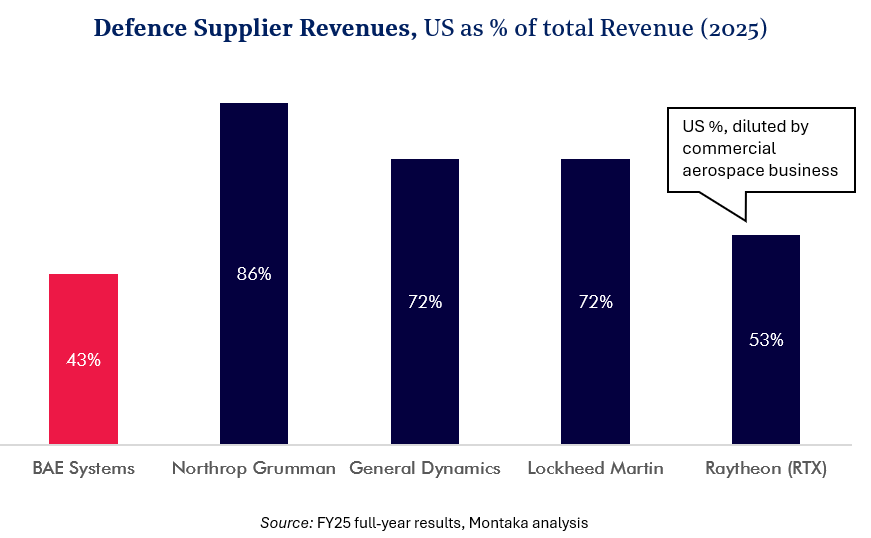
Unlike the major US defence contractors, BAE’s unique geographical footprint better insulates it from the fiscal risks of any single nation while positioning the company for higher military expenditures across both sides of the Atlantic and abroad.
-
Strong backlog visibility
BAE’s extensive R&D capabilities and long-standing relationships are reflected in its assignment to several marquee, sovereign defence programs including the AUKUS submarine project in Australia and the Global Combat Air Programme (GCAP) between Japan, Italy and the UK. These multi-decade initiatives have contributed to a record £84B order book for BAE (31 Dec 2025), providing strong visibility to utility-like cash flows.
-
Asymmetric upside & portfolio diversification
BAE has compounded earnings per share (EPS) at a high-single digit rate over the last 10 years and has delivered 22 consecutive years of dividend growth for shareholders.
There is asymmetry between the defensive nature of the company and the significant upside we see from potential future geopolitical escalations. Scenarios such as Russian incursions on Europe or Chinese aggression towards Taiwan could result in defence budgets surging well beyond already increased targets.
Finally, BAE also helps to diversify against the longer-duration, technology-oriented segments of our portfolio.
Montaka’s investment philosophy centres on identifying and investing behind structural transformations. The geopolitical shift toward a more fragmented, multipolar world—and the resulting rearmament cycle should enable quality leaders like BAE to benefit from sustained defence spending increase over the coming decade.
We initiated the BAE position at the beginning of the year. Subsequent volatility including the conflict in Iran, has contributed positively to the stock’s performance to date.
References:
[i] NATO (1949). The North Atlantic Treaty, Article 5. Washington D.C., April 4.
[ii] NATO (2026). Secretary General’s Annual Report 2025. Brussels, March 26.
[iii] Alozious, J. (2021). Defence and Peace Economics.
[iv] Council on Foreign Relations (2025). NATO Agrees to New Defense Spending Target. June 25.
[v] European Commission (2026). Commission approves first wave of defence funding for eight Member States under SAFE.
[vi] UK Government; 10 Downing Street (2025). Prime Minister sets out biggest sustained increase in defence spending since the Cold War. February 25.
[vii] NATO (2022). The Secretary General’s Annual Report 2021: Annex – Defence Expenditure of NATO Countries (2014-2021). Brussels, March 31.
[viii] Japan Ministry of Defense (2026). Defense Programs and Budget of Japan: FY2026 Draft.
[ix] Washington Post / President Lai Ching-te (Nov 25, 2025). Opinion: An Unassailable Taiwan.
[x] GAMI / Breaking Defense (2025). Saudi Arabia increases defense spending to $78B in 2025
[xi] Council on Foreign Relations (2026). Trump’s $1.5 Trillion Defense Budget Should Not Come as a Surprise. January 8
Tim Le is the Senior Research Analyst at Montaka Global Investments. To learn more about Montaka, please call +612 7202 0100 or leave us a line at montaka.com/contact-us
Podcast: Join the Montaka Global Investments team on Spotify as they chat about the market dynamics that shape their investing decisions in Spotlight Series Podcast. Follow along as we share real-time examples and investing tips that govern our stock picks. Click below to listen. Alternatively, click on this link: https://podcasters.spotify.com/pod/show/montaka